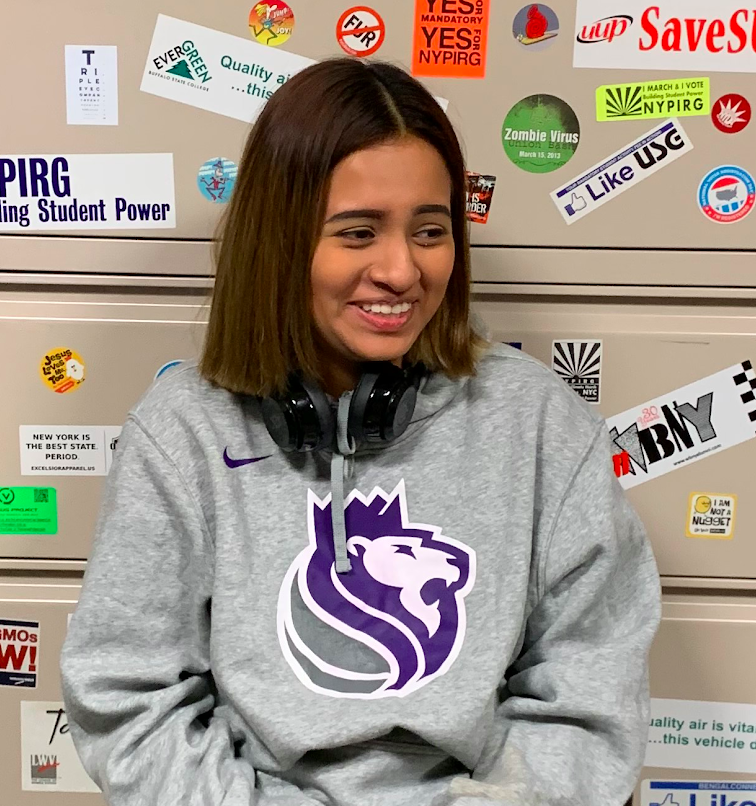
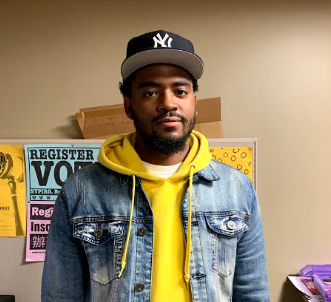
I am a senior at Queens College majoring in film studies and English. I love to analyze stories in books and movies so that informed my choice of major. I receive the Federal Pell Grant and TAP as part of my financial aid. I try to save some money by getting books from the library, but for textbooks, my bill can climb into the hundreds. Big science and anthropology textbooks have been the most expensive for my required classes. And often, when you get to major courses, they ask for books that are rare to find, and ordering them online takes a long time. Textbooks eat up a lot of my financial aid refund that I could use on living expenses.
One semester, I was late applying for aid through FAFSA. When I was finally able to apply, I accidently applied for the wrong year. As a result, I owed the College money when my registration appointment came, and I couldn’t register. I had to pay down my balance before I could create my class schedule for the next semester. With the help of my parents, I was able to do this, but I don’t know what would have happened if they weren’t there to help me. Mistakes happen, and someone’s education shouldn’t be put on hold as a result.
I feel that offices at my college could communicate more with students about problems with their accounts so that the students can fix the problems before it’s too late. This could be done through email or having more effective campus outreach. These offices could use more funding for these programs and resources to fix infrastructure issues all over the school. Social services on the campus could also be improved, and the course selection widened, especially for smaller majors.
I am a junior at Queens College majoring in both Art Education and Illustration. I chose Queens College because it is one of the only public schools with both these majors. I’ve been drawing since I was a child, so I wanted to take the opportunity to get a degree specific to my interests. I also love to help people learn, so art education felt like the perfect match.
The financial aid I get doesn’t cover the full cost of attendance, and these extra costs cut into the incredibly tight budget my family has to survive. It demolishes my family’s ability to afford our basic needs. In New York, we all pay too much in rent and bills, and for my family, any extra cost of any kind makes it so that we can’t afford groceries.
My mother is a single parent supporting two children through college. Her health is deteriorating, and work is getting harder for her. Also, financial aid takes forever to process. When it doesn’t get processed on time, my account goes on hold, and I can’t register for my classes for the next semester. Right now, with the threat of $9,000 coming out of my family’s empty pockets, the future of my education is at risk.
I live in the dorms on campus because my family lives almost two hours away. I made the decision not to live at home because I wanted to ensure that nothing got in the way of my education, including traffic. But I feel like every time I make the right decision for my education, it seems like everything else has to take a hit—especially my finances.
If school were free or if I got more aid, I wouldn’t have to worry about these things, and I wouldn’t have to put my family into unimaginable debt just hoping things work out in the future. I shouldn’t have to tank my family’s livelihood just for a chance at success.
Credit-wise I’m a senior, but I will be here until 2021. I would like to go to law school, but I can’t afford to pay for LSAT exam, which is a couple hundred dollars. I came from the Fashion Institute of Technology graduating with a major in pattern-making technology. Then I went to John Jay where I got my Bachelors in English and minor in Law, and now I’m studying at City Tech as a Law and Paralegal major. I continued to go to school thinking that TAP would cover it because they didn’t tell me that they only cover four years of school. I pay for school through student loans now.
My parents pay for my textbooks, I receive SNAP for food, and I am concerned about graduating on time. Tuition is going up, and I can’t afford it, which means I can’t take full amounts of classes like I want to. I had to go part-time at one point because I couldn’t afford to take full-time credits.
I got sick senior year of my first bachelors, so I had to take a semester off, and then I had a miscarriage so I took another semester off, and what they don’t tell you is that they count those semesters off as part of the 4 years of TAP.
I really need the prices to come down because I’m a single parent with a 14 year-old daughter, and I’m trying to make ends meet. I’m trying to further my career, but it’s too expensive.
I am majoring in law and paralegal studies at City Tech, and it is my 5th year. I want to go to law school after college and then run for the NY Senate, and you never know where else I may end up. I feel like the route taken by most politicians is going to law school and then end up being politically active.
Financial aid covers most of my costs, but I have to pay some out of pocket— approximately $500 to $1000. Before City Tech, I attended various universities, private and public, and saw how the financial aid system worked in those schools. It’s when I got to City Tech that I saw the deficiencies in the system.
I receive TAP and Pell, and it’s not enough to cover my tuition costs, and my parents don’t have the money necessary to adequately fund my higher education. I have three other siblings that are attending college and one that is in 12th grade, looking at colleges now.
I have to go on a deferred payment plan and have been dropped from a course because I didn’t have the money to pay on time. You only have the week from the start of the semester to apply for the deferred payment plan, and if you miss that, you have to pay the amount in full. I was lucky that I called the financial office and asked if there was an alternative to paying all at once.
How do other students find out about this if one has to call to find out about these alternative options? I personally told a number of students that the deferred payment plan was an option, instead of dropping out all together and losing a semester of coursework. They were not aware of this.
Financial aid usually pays for textbooks, but I have to pay out of pocket before the money comes in, which is usually the mid-point, or at the end of the semester. My parents pay for food. If I didn’t receive financial aid, it would be nearly impossible for me to go to school. I am concerned about graduating on time, especially since they’ve said I exhausted my financial aid.
We need a fully funded CUNY, so more people who don’t currently have access to higher education are able to gain access and not be held back socially or economically. That should be the goal. Prospective college students should only have to focus on their schoolwork, instead of on how they will be able to pay for their next semester of college.
I am a senior at SUNY New Paltz majoring in communication disorders with a minor in deaf studies. After college, I intend on pursuing a career as an audiologist. I am currently employed as a cashier at the Student Union Building, and I also do catering for on-campus events.
Working on campus is the only way I can ensure that I will stay enrolled in school. I have always had to work in order to manage my expenses, especially school fees that were mandatory for me to pay out-of-pocket in order to stay in school. I have come really close to being kicked out of school because my financial aid was not enough to cover all of the costs. Thankfully, I was able to use the money I received from my campus jobs to pay off any remaining amounts.
I receive both TAP and Pell Grants, but that is not enough. I had to increase my unsubsidized loans for it to cover tuition and room and board. I could only get approval to increase my unsubsidized loan if my Parent Plus loan was denied.
I am an Educational Opportunity Student (EOP), and this program has helped me cover the majority of the costs for school. Without EOP, I’m not sure if I would still be in college. This program has been a great help for me from the beginning.
I am a junior at SUNY New Paltz, studying sociology with a concentration in criminology and a minor in communications. On campus I have been a student assistant at the Sweets N’ Treats bakery and a student chef at Peregrine Dining Hall. Working at these locations provided help with finances and helped me buy food because after a while campus food gets old. Working on campus also helped me pay off the money that I owed to the school because financial aid couldn’t cover all of my tuition and fees even though I receive the maximum amount for the TAP and Pell Grants.
I am very grateful to be a part of the Educational Opportunity Program (EOP). EOP has helped me in tons of ways. First, in terms of financial aid, they provide up to $1,400 towards financial aid. Although it does help, it still did not cover all of my financial needs for the semesters. Sometimes towards the end, the program receives leftover money from schools in order to help fund the missing amount from a student’s financial aid.
EOP has helped guide me through the criteria of college by giving me an idea of what to expect from classes, especially since it was a big transition from high school. EOP has also helped me in the process of deciding what major was best for me, and the program provided connections in order for me to succeed. Those resources are even there for me when the semester hits and anxiety and stress takes over my body.
I have been facing problems with financial aid since I started school. I was never told that the amount of financial aid you receive depends on the amount of credits you earn in a year. One semester during freshman year I took 12 credits instead of 15, and you need 30 credits to be considered a sophomore. At the beginning of my sophomore semester, I had to take about a thousand dollars out-of-pocket in order to pay off the school since my financial aid didn’t cover all of my bill. And with loans, I’m not allowed to take out a certain amount of money because I didn’t qualify to be a sophomore that year. I was too scared to take out another loan (the Parent Plus loan).
It’s really hard to pay that amount because $1,000 isn’t pocket change, especially since I come from a family that relies on an insignificant income. I had to rely on the funds that I earned from working at the on-campus job that I had. This year I was faced with taking out the Parent Plus loan, and I ended up doing it. A lot of my friends dropped out because they couldn’t pay the amount that they owed to the school.
While I’ve been lucky enough to have family members that have the means to support me through school, tuition and fee hikes have taken a major toll on my friends. Almost everyone I know is taking a full load of science classes that include lab sessions. They all have to work long hours.
Because we are majoring in hard sciences, textbooks can easily be over a thousand dollars a semester on top of rising tuition costs. We’re expected to either pay now or take out tens of thousands in loans that we can pay if we get jobs after college. This makes it stressful to just be a student because getting a well-paying job is so important.
We’re supposed to be the ones protecting our planet and developing new technologies to fight climate change, but how can we do that if learning how to do that is so difficult? Almost everyone I know talks about how worried they are about their future post-graduation.
I’m also extremely worried about the SUNY system because I have a younger brother and sister who will both be going to college in a few years. If the economy tanks, and my parents lose their jobs, what are my siblings supposed to do? They haven’t been able to save for themselves because they’ve been brought up thinking that they’ll be okay. But if school keeps getting more expensive, I’m not sure what they’ll be able to do.
My parents have been generous enough to pay for my tuition thus far—even though they have to pay for two mortgages, their cars plus mine, utility bills, and more. It’s making our already unstable financial situation worse. My mom is going to have to sell her house and move to an apartment in a less expensive city once my brother turns 18.
My parents make “too much” in salary, as high school teachers, for me or my brother to qualify for financial aid from FAFSA or need-based scholarships. In reality, we’re struggling financially.
I have transferred between colleges multiple times, between an out-of-state public college, a SUNY community college, CUNY 4-year school, and finally a SUNY 4-year school. When transferring into CUNY, I had difficulty communicating with an advisor, and they did nothing to help me get into the major I wanted. Then, once I transferred here, the first advisor I spoke to had me take two classes that I ended up not needing with my transfer credits.
If I had taken literature classes for my major instead of those unnecessary classes, I probably wouldn’t be cramming all my major requirements (as well as a gym requirement) into my last two semesters.
I am a freshman at Buffalo State. I am a political science major from Queens, NY. I came to Buffalo State planning on majoring in political science because I’ve always been interested in politics and watch the news a lot, though it was comedy shows like the Daily Show that first got me into politics. I want to go to law school so I can practice public interest law, serving clients who can’t afford a lawyer. This means, of all my siblings, I will be the odd one out—the only non-accountant!
I went to the High School of Environmental Studies in Manhattan, where the emphasis was on environmental science. That got me interested in environmental studies. I decided on Buffalo State because I definitely didn’t want to stay in the city for college and wanted a change of scenery so I could focus on studying.
As a freshman, textbooks have been a concern because, even though rentals are sometimes an inexpensive options, it’s first come first served. The bookstore is almost always out of rentals when I go to buy them, which means I have to pay full price. Luckily this term, I managed to get a few rentals for $130, but many classes have multiple books that are hardly ever used. You can’t really tell what books you’re actually going to need, and it becomes an expensive guessing game.
I am not working at the moment because, even though I qualify for federal work-study, there aren’t nearly enough on-campus jobs for all the students who qualify. That means I have to look for off-campus jobs. Given Buffalo weather and not having a car, my choices are limited. It’s important to have a job because of how expensive college life is.
With TAP and all the scholarships I received, I still pay about $5000 toward tuition per semester. My family is paying these costs out of pocket, and I currently can’t register because I haven’t paid for the previous term. I can’t even look at my GPA if I wanted to transfer because everything is frozen until I pay. Courses for my major could get filled before I have time to pay up and register. Financial aid advising needs to be clearer so students know where they stand.
I’m from Harlem in New York, and I’m a sociology major and criminal justice minor at Buffalo State. Before coming to Buffalo State, I attended Promise Academy, a charter school in Harlem which was very helpful in getting me and my classmates through high school to college. Growing up, I always wanted to do criminal justice because it was always a passion of mine, especially around policies like stop-and-frisk and police harassment of African-Americans. I wanted to learn about the criminal justice system as it is so that I could help to implement changes.
I originally started college at Gannon University in Erie, Pennsylvania on an athletic scholarship playing basketball, but it was too much of a shock—and too different from what I was used to in New York City—for me to adjust to the change of environment. I left mid-semester and applied to different schools and Buffalo State got back to me first. Because I left Gannon mid-semester, though, my grades never transferred, and I am not currently receiving a scholarship. Thankfully, I didn’t have to take out loans, but my family and I are paying out of pocket around $5000-6000 per semester.
Though I get some funding for textbooks through Promise Academy, the bill easily adds up to $500 per semester, and this term I have one class with six different assigned texts. In my experience, a lot of the time these books aren’t useful, and we only use them once or twice.
I have had advisors, but I have had difficulty connecting with them. I have to reach out to them, and when I started and was struggling, my advisor wasn’t reaching out to me and didn’t ask about how I was doing. I think we need more funding for advisors so that they can monitor students more actively. As it is, I didn’t meet my advisor until my third year here.
A clearer and better funded system needs to be implemented to allow students to get advice in a timely way. As a senior, now I know the people to talk to and have no problem going to the chair of my department. So now I have better resources, but I’m at the end of my time at Buffalo State. There needs to be better communication about resources that are available and how to get to them. Students like me shouldn’t fall off the grid and not be able to catch up with their work. I think better funding would increase graduation rates.